The Australian Open men’s singles tournament stands as one of tennis’ oldest and most significant competitions.
Records from the championship extend back to 1905, providing a century-spanning archive of champions, finalists, and match results.
This dataset documents every men’s singles final from the tournament’s inception through 2025.
The Australian Open men’s singles winners list from 1905 to 2025 captures the evolution of tennis across multiple eras.
Each champion reflects the standards of play during their respective period.
The tournament’s records show clear transitions in playing style, nationality distribution, and competitive dominance over time.
Historical significance attaches to this competition due to its longevity and status as a major championship.
Finals data, scores, and winner information form an essential reference for tennis history.
Australian Open Men’s Singles Winners List from 1905 to 2025
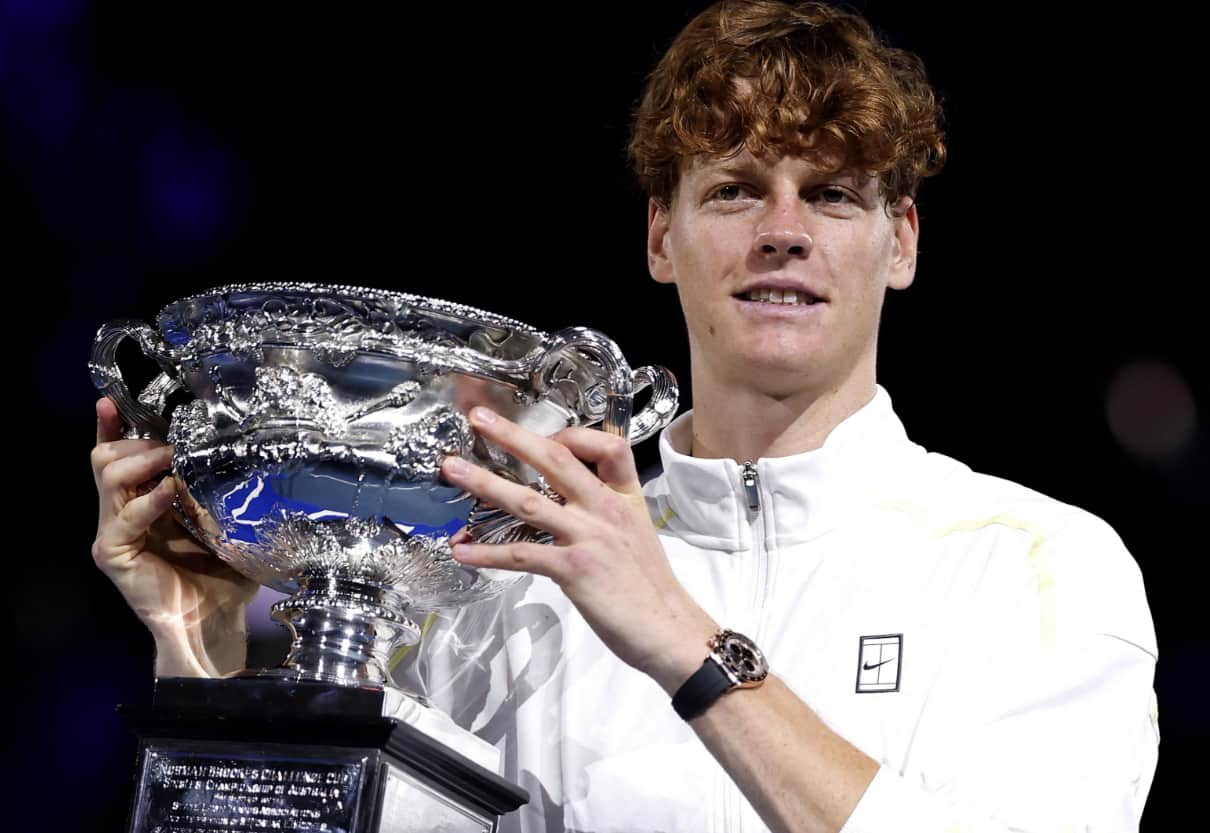
Understanding the complete role of champions requires access to verified historical records spanning 120 years of competitive tennis.
Complete Australian Open Men’s Singles Winners List from 1905 to 2025
| Year | Winner | Runner-up | Final Score |
|---|---|---|---|
| 2025 | Jannik Sinner (ITA) | Alexander Zverev (GER) | 6-3, 7-6(4), 6-3 |
| 2024 | Jannik Sinner (ITA) | Daniil Medvedev (RUS) | 3-6, 3-6, 6-4, 6-4, 6-3 |
| 2023 | Novak Djokovic (SRB) | Stefanos Tsitsipas (GRE) | 6-3, 7-6(4), 7-6(5) |
| 2022 | Rafael Nadal (ESP) | Daniil Medvedev (RUS) | 2-6, 6-7(5), 6-4, 6-4, 7-5 |
| 2021 | Novak Djokovic (SRB) | Daniil Medvedev (RUS) | 7-5, 6-2, 6-2 |
| 2020 | Novak Djokovic (SRB) | Dominic Thiem (AUT) | 6-4, 4-6, 2-6, 6-3, 6-4 |
| 2019 | Novak Djokovic (SRB) | Rafael Nadal (ESP) | 6-3, 6-2, 6-3 |
| 2018 | Roger Federer (SUI) | Marin Cilic (CRO) | 6-2, 6-7(5), 6-3, 3-6, 6-1 |
| 2017 | Roger Federer (SUI) | Rafael Nadal (ESP) | 6-4, 3-6, 6-1, 3-6, 6-3 |
| 2016 | Novak Djokovic (SRB) | Andy Murray (GBR) | 6-1, 7-5, 7-6(3) |
| 2015 | Novak Djokovic (SRB) | Andy Murray (GBR) | 7-6(5), 6-7(4), 6-3, 6-0 |
| 2014 | Stan Wawrinka (SUI) | Rafael Nadal (ESP) | 6-3, 6-2, 3-6, 6-3 |
| 2013 | Novak Djokovic (SRB) | Andy Murray (GBR) | 6-7, 7-6, 6-3, 6-2 |
| 2012 | Novak Djokovic (SRB) | Rafael Nadal (ESP) | 5-7, 6-4, 6-2, 6-7, 7-5 |
| 2011 | Novak Djokovic (SRB) | Andy Murray (GBR) | 6-4, 6-2, 6-3 |
| 2010 | Roger Federer (SUI) | Andy Murray (GBR) | 6-3, 6-4, 7-6(11) |
| 2009 | Rafael Nadal (ESP) | Roger Federer (SUI) | 7-5, 3-6, 7-6(3), 3-6, 6-2 |
| 2008 | Novak Djokovic (SRB) | Jo-Wilfried Tsonga (FRA) | 4-6, 6-4, 6-3, 7-6(2) |
| 2007 | Roger Federer (SUI) | Fernando Gonzalez (CHI) | 7-6(2), 6-4, 6-4 |
| 2006 | Roger Federer (SUI) | Marcos Baghdatis (CYP) | 5-7, 7-5, 6-0, 6-2 |
| 2005 | Marat Safin (RUS) | Lleyton Hewitt (AUS) | 1-6, 6-3, 6-4, 6-4 |
| 2004 | Roger Federer (SUI) | Marat Safin (RUS) | 7-6(3), 6-4, 6-2 |
| 2003 | Andre Agassi (USA) | Rainer Schuettler (GER) | 6-2, 6-2, 6-1 |
| 2002 | Thomas Johansson (SWE) | Marat Safin (RUS) | 3-6, 6-4, 6-4, 7-6(4) |
| 2001 | Andre Agassi (USA) | Arnaud Clement (FRA) | 6-4, 6-2, 6-2 |
| 2000 | Andre Agassi (USA) | Yevgeny Kafelnikov (RUS) | 3-6, 6-3, 6-2, 6-4 |
| 1999 | Yevgeny Kafelnikov (RUS) | Thomas Enqvist (SWE) | 4-6, 6-0, 6-3, 7-6(1) |
| 1998 | Petr Korda (CZE) | Marcelo Rios (CHI) | 6-2, 6-2, 6-2 |
| 1997 | Pete Sampras (USA) | Carlos Moya (ESP) | 6-2, 6-3, 6-3 |
| 1996 | Boris Becker (GER) | Michael Chang (USA) | 6-2, 6-4, 2-6, 6-2 |
| 1995 | Andre Agassi (USA) | Pete Sampras (USA) | 4-6, 6-1, 7-6(6), 6-4 |
| 1994 | Pete Sampras (USA) | Todd Martin (USA) | 7-6(4), 6-4, 6-4 |
| 1993 | Jim Courier (USA) | Stefan Edberg (SWE) | 6-2, 6-1, 2-6, 7-5 |
| 1992 | Jim Courier (USA) | Stefan Edberg (SWE) | 6-3, 3-6, 6-4, 6-2 |
| 1991 | Boris Becker (GER) | Ivan Lendl (TCH) | 1-6, 6-4, 6-4, 6-4 |
| 1990 | Ivan Lendl (TCH) | Stefan Edberg (SWE) | 4-6, 7-6(3), 5-2, retired |
| 1989 | Ivan Lendl (TCH) | Miloslav Mecir (TCH) | 6-2, 6-2, 6-2 |
| 1988 | Mats Wilander (SWE) | Pat Cash (AUS) | 6-3, 6-7(3), 3-6, 6-1, 8-6 |
| 1987 | Stefan Edberg (SWE) | Pat Cash (AUS) | 6-3, 6-4, 3-6, 5-7, 6-3 |
| 1985 | Stefan Edberg (SWE) | Mats Wilander (SWE) | 6-4, 6-3, 6-3 |
| 1984 | Mats Wilander (SWE) | Kevin Curren (RSA) | 6-7(5), 6-4, 7-6(3), 6-2 |
| 1983 | Mats Wilander (SWE) | Ivan Lendl (TCH) | 6-1, 6-4, 6-4 |
| 1982 | Johan Kriek (USA) | Steve Denton (USA) | 6-3, 6-3, 6-2 |
| 1981 | Johan Kriek (USA) | Steve Denton (USA) | 6-2, 7-6(1), 6-7(1), 6-4 |
| 1980 | Brian Teacher (USA) | Kim Warwick (AUS) | 7-5, 7-6(4), 6-3 |
| 1979 | Guillermo Vilas (ARG) | John Sadri (USA) | 7-6(4), 6-3, 6-2 |
| 1978 | Guillermo Vilas (ARG) | John Marks (AUS) | 6-4, 6-4, 3-6, 6-3 |
| 1977 | Roscoe Tanner (USA) | Guillermo Vilas (ARG) | 6-3, 6-3, 6-3 |
| 1977 | Vitas Gerulaitis (USA) | John Lloyd (GBR) | 6-3, 7-6, 5-7, 3-6, 6-2 |
| 1976 | Mark Edmondson (AUS) | John Newcombe (AUS) | 6-7, 6-3, 7-6, 6-1 |
| 1975 | John Newcombe (AUS) | Jimmy Connors (USA) | 7-5, 3-6, 6-4, 7-6(7) |
| 1974 | Jimmy Connors (USA) | Phil Dent (AUS) | 7-6(7), 6-4, 4-6, 6-3 |
| 1973 | John Newcombe (AUS) | Onny Parun (NZL) | 6-3, 6-7, 7-5, 6-1 |
| 1972 | Ken Rosewall (AUS) | Malcolm Anderson (AUS) | 7-6(2), 6-3, 7-5 |
| 1971 | Ken Rosewall (AUS) | Arthur Ashe (USA) | 6-1, 7-5, 6-3 |
| 1970 | Arthur Ashe (USA) | Dick Crealy (AUS) | 6-4, 9-7, 6-2 |
| 1969 | Rod Laver (AUS) | Andres Gimeno (ESP) | 6-3, 6-4, 7-5 |
| 1968 | William Bowrey (AUS) | Juan Gisbert (ESP) | 7-5, 2-6, 9-7, 6-4 |
| 1967 | Roy Emerson (AUS) | Arthur Ashe (USA) | 6-4, 6-1, 6-4 |
| 1966 | Roy Emerson (AUS) | Arthur Ashe (USA) | 6-4, 6-8, 6-2, 6-3 |
| 1965 | Roy Emerson (AUS) | Fred Stolle (AUS) | 7-9, 2-6, 6-4, 7-5, 6-1 |
| 1964 | Roy Emerson (AUS) | Fred Stolle (AUS) | 6-3, 6-4, 6-2 |
| 1963 | Roy Emerson (AUS) | Ken Fletcher (AUS) | 6-3, 6-3, 6-1 |
| 1962 | Rod Laver (AUS) | Roy Emerson (AUS) | 8-6, 0-6, 6-4, 6-4 |
| 1961 | Roy Emerson (AUS) | Rod Laver (AUS) | 1-6, 6-3, 7-5, 6-4 |
| 1960 | Rod Laver (AUS) | Neale Fraser (AUS) | 5-7, 3-6, 6-3, 8-6, 8-6 |
| 1959 | Alex Olmedo (USA) | Neale Fraser (AUS) | 6-1, 6-2, 3-6, 6-3 |
| 1958 | Ashley Cooper (AUS) | Malcolm Anderson (AUS) | 7-5, 6-3, 6-4 |
| 1957 | Ashley Cooper (AUS) | Neale Fraser (AUS) | 6-3, 9-11, 6-4, 6-2 |
| 1956 | Lew Hoad (AUS) | Ken Rosewall (AUS) | 6-4, 3-6, 6-4, 7-5 |
| 1955 | Ken Rosewall (AUS) | Lew Hoad (AUS) | 9-7, 6-4, 6-4 |
| 1954 | Mervyn Rose (AUS) | Rex Hartwig (AUS) | 6-2, 0-6, 6-4, 6-2 |
| 1953 | Ken Rosewall (AUS) | Mervyn Rose (AUS) | 6-0, 6-3, 6-4 |
| 1952 | Ken McGregor (AUS) | Frank Sedgman (AUS) | 7-5, 12-10, 2-6, 6-2 |
| 1951 | Dick Savitt (USA) | Ken McGregor (AUS) | 6-3, 2-6, 6-3, 6-1 |
| 1950 | Frank Sedgman (AUS) | Ken McGregor (AUS) | 6-3, 6-4, 4-6, 6-1 |
| 1949 | Frank Sedgman (AUS) | John Bromwich (AUS) | 6-3, 6-2, 6-2 |
| 1948 | Adrian Quist (AUS) | John Bromwich (AUS) | 6-4, 3-6, 6-3, 2-6, 6-3 |
| 1947 | Dinny Pails (AUS) | John Bromwich (AUS) | 4-6, 6-4, 3-6, 7-5, 8-6 |
| 1946 | John Bromwich (AUS) | Dinny Pails (AUS) | 5-7, 6-3, 7-5, 3-6, 6-2 |
| 1940 | Adrian Quist (AUS) | Jack Crawford (AUS) | 6-3, 6-1, 6-2 |
| 1939 | John Bromwich (AUS) | Adrian Quist (AUS) | 6-4, 6-1, 6-3 |
| 1938 | Don Budge (USA) | John Bromwich (AUS) | 6-4, 6-2, 6-1 |
| 1937 | Vivian McGrath (AUS) | John Bromwich (AUS) | 6-3, 1-6, 6-0, 2-6, 6-1 |
| 1936 | Adrian Quist (AUS) | Jack Crawford (AUS) | 6-2, 6-3, 4-6, 3-6, 9-7 |
| 1935 | Jack Crawford (AUS) | Fred Perry (GBR) | 2-6, 6-4, 6-4, 6-4 |
| 1934 | Fred Perry (GBR) | Jack Crawford (AUS) | 6-3, 7-5, 6-1 |
| 1933 | Jack Crawford (AUS) | Keith Gledhill (USA) | 2-6, 7-5, 6-3, 6-2 |
| 1932 | Jack Crawford (AUS) | Harry Hopman (AUS) | 4-6, 6-3, 3-6, 6-3, 6-1 |
| 1931 | Jack Crawford (AUS) | Harry Hopman (AUS) | 6-4, 6-2, 2-6, 6-1 |
| 1930 | Edgar Moon (AUS) | Harry Hopman (AUS) | 6-3, 6-1, 6-3 |
| 1929 | John Colin Gregory (GBR) | Richard Schlesinger (AUS) | 6-2, 6-2, 5-7, 7-5 |
| 1928 | Jean Borotra (FRA) | Jack Cummings (AUS) | 6-4, 6-1, 4-6, 5-7, 6-3 |
| 1927 | Gerald Patterson (AUS) | John Hawkes (AUS) | 3-6, 6-4, 3-6, 18-16, 6-3 |
| 1926 | John Hawkes (AUS) | James Willard (AUS) | 6-1, 6-3, 6-1 |
| 1925 | James Anderson (AUS) | Gerald Patterson (AUS) | 11-9, 2-6, 6-2, 6-3 |
| 1924 | James Anderson (AUS) | Richard Schlesinger (AUS) | 6-3, 6-4, 3-6, 5-7, 6-3 |
| 1923 | Pat O’Hara Wood (AUS) | Bert St. John (AUS) | 6-1, 6-1, 6-3 |
| 1922 | James Anderson (AUS) | Gerald Patterson (AUS) | 6-0, 3-6, 3-6, 6-3, 6-2 |
| 1921 | Rhys Gemmell (AUS) | Alf Hedeman (AUS) | 7-5, 6-1, 6-4 |
| 1920 | Pat O’Hara Wood (AUS) | Ronald Thomas (AUS) | 6-3, 4-6, 6-8, 6-1, 6-3 |
| 1919 | Algernon Kingscote (BRI) | Eric Pockley (AUS) | 6-4, 6-0, 6-3 |
| 1915 | Gordon Lowe (BRI) | Horace Rice (AUS) | 4-6, 6-1, 6-1, 6-4 |
| 1914 | Arthur O’Hara Wood (AUS) | Gerald Patterson (AUS) | 6-4, 6-3, 5-7, 6-1 |
| 1913 | Ernie Parker (AUS) | Harry Parker (NZL) | 2-6, 6-1, 6-3, 6-2 |
| 1912 | James Cecil Parke (BRI) | Alfred Beamish (BRI) | 3-6, 6-3, 1-6, 6-1, 7-5 |
| 1911 | Norman Brookes (AUS) | Horace Rice (AUS) | 6-1, 6-2, 6-3 |
| 1910 | Rodney Heath (AUS) | Horace Rice (AUS) | 6-4, 6-3, 6-2 |
| 1909 | Anthony Wilding (NZL) | Ernie Parker (AUS) | 6-1, 7-5, 6-2 |
| 1908 | Fred Alexander (USA) | Alfred Dunlop (AUS) | 3-6, 3-6, 6-0, 6-2, 6-3 |
| 1907 | Horace Rice (AUS) | Harry Parker (NZL) | 6-3, 6-4, 6-4 |
| 1906 | Anthony Wilding (NZL) | Francis Fisher (NZL) | 6-0, 6-4, 6-4 |
| 1905 | Rodney Heath (AUS) | Arthur Curtis (AUS) | 4-6, 6-3, 6-4, 6-4 |
Key Insights from the Winners List
Early Australian Dominance
Australian players held the championship title for decades during the pre-Open Era period. Between 1905 and the 1960s, players from Australia claimed the majority of titles. This geographic concentration reflected both the tournament’s location and the strength of the local tennis infrastructure during that era.
Open Era Shift in Competition
The onset of professional tennis in 1968 introduced a notable change in the distribution of champions. International competitors from Europe, the United States, and other regions increased their representation in finals. Champion nationality patterns shifted significantly after this transition to professional play.
Rise of Multi-Title Champions
Certain players won the championship multiple times across different years. The records show instances of players claiming victories in consecutive or non-consecutive seasons. This pattern became more pronounced in recent decades, reflecting both improved athletic performance and the sustainability of elite-level play.
Five-Set Finals Becoming Common
Match length evolved over the tournament’s history. Earlier finals frequently extended to five sets, with scores reflecting tight competition. Modern finals vary more in duration, though five-set outcomes remain regular occurrences in championship matches across decades.
Modern Baseline Dominance
Contemporary championship records reflect changes in playing styles. Recent winners display patterns consistent with baseline-focused tactics. Court surface characteristics and equipment evolution contributed to shifts in how champions approach match play.
Frequently Asked Questions
- What is the Australian Open men’s singles winners list from 1905 to 2025?
This document provides a complete historical record of every men’s singles champion at the Australian Open from 1905 through 2025. The list includes the winner, runner-up, and final match score for each year.
- Who has won the Australian Open men’s singles the most times?
The Australian Open men’s singles winners list from 1905 to 2025 shows multiple players with four or more titles. Roy Emerson, Ken Rosewall, Adrian Quist, and Jack Crawford each won multiple championships during the pre-Open and early Open Era periods. Recent era champions also show repeated victories.
- When did the Open Era begin at the Australian Open?
Professional tennis started in 1968, which marked the transition to the Open Era. The championship records reflect this change with increased international participation from that point forward.
- Why are some finals longer than others?
Match duration depends on the competitive balance between the finalists. Closely matched opponents often extend matches to full five sets. Dominant performances by one player can result in shorter finals completed in three or four sets.
Conclusion:
The complete Australian Open men’s singles winners list from 1905 to 2025 documents 120 years of championship tennis.
This historical archive captures the evolution of the sport across multiple generations of competitors and playing eras.
Records include names from amateur periods, transition years, and the modern professional era.
Access to this verified data enables historical analysis and statistical research. The tournament’s longevity positions it as a critical reference point in tennis documentation.
Understanding the full span of champions and finalists requires reference to all 120 years of recorded results.
Key historical patterns visible in the records:
- Australian player dominance shifted to international representation after 1968
- Playing styles evolved with changes to court surfaces and equipment standards
- Championship continuity spans from early amateur competitors to contemporary professionals
- Multi-title winners appear throughout the tournament’s entire recorded history
Also Check:
- Carlos Alcaraz vs Novak Djokovic Head to Head Records
- Richest Male Tennis Players in History with Net Worth
- Longest Men’s Singles Matches in Australian Open History
- Longest Women’s Singles Matches in Australian Open History
- Most Grand Slam Titles Won by Male Tennis Players List
- Youngest Career Grand Slam Winners in Men’s Tennis
About the Author
