Cricket income in India is taxed under multiple heads, not one uniform rule.
The classification depends on the nature of payment, source, and the player’s residential status.
In India, cricket players are taxed based on the source and nature of their earnings.
Income from matches, leagues, endorsements, and prizes is taxed under different provisions, mainly as professional income, depending on residential status and payment origin.
Cricket generates revenue through diverse channels—boards, franchises, brands, tournaments, and media platforms.
Each channel triggers distinct tax provisions under the Income Tax Act.
The cricket player income tax India framework classifies income across multiple heads: Business/Profession for performance-based earnings, Other Sources for prizes, and various exemptions for government awards.
Classification determines tax rates, TDS applicability, and GST obligations. Misclassification leads to incorrect filing and potential reassessment.
This complexity stems from cricket’s dual nature—both athletic performance and commercial activity.
Players operate as independent professionals, not employees, which fundamentally alters their tax treatment compared to salaried individuals.
How Income Tax Applies to Cricket Players in India?
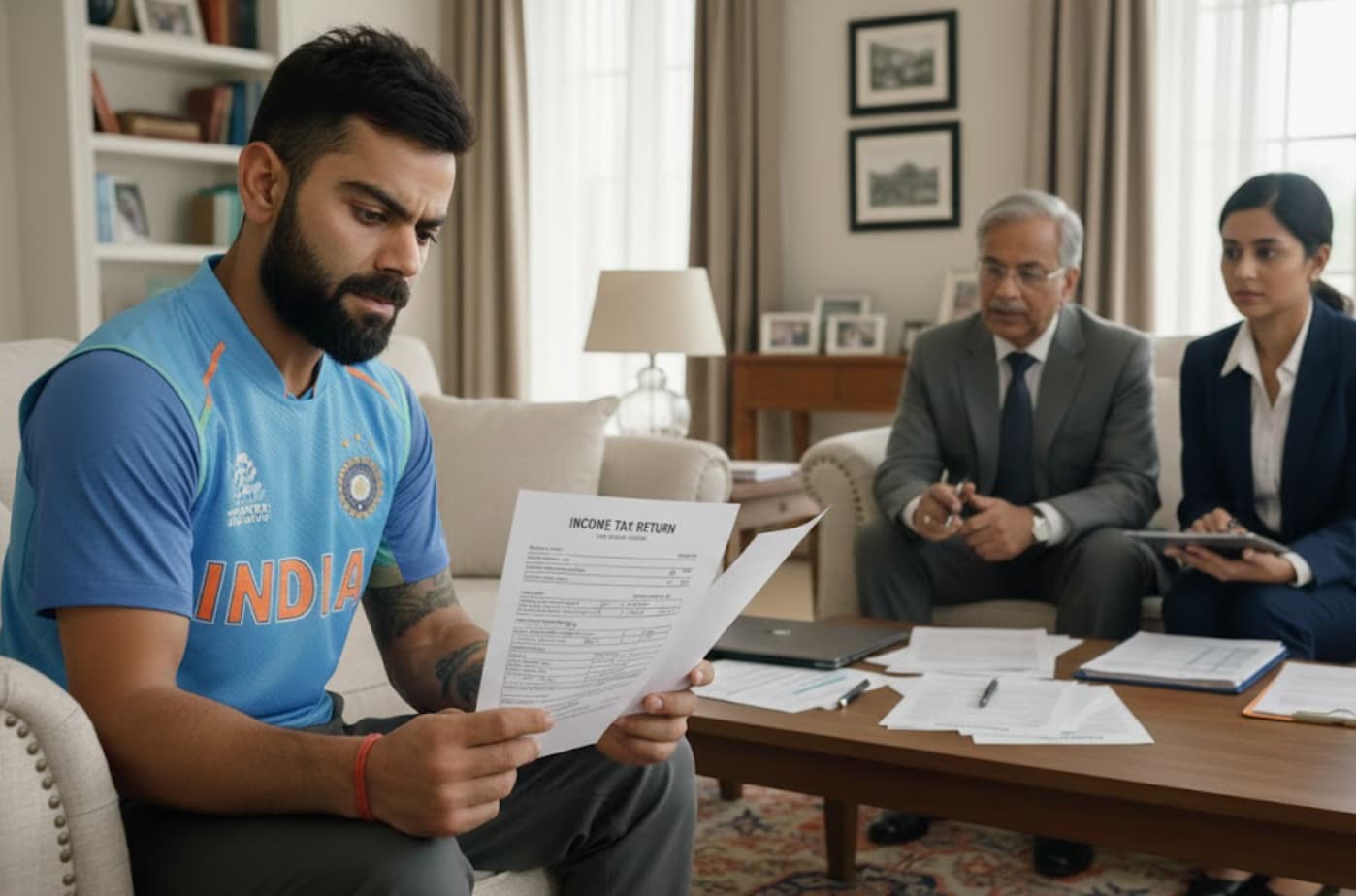
Understanding these distinctions matters for accurate reporting and compliance verification.
Professional Nature of Cricket Income Under Indian Tax Law
Cricket is legally classified as a profession, not employment.
This classification forms the foundation of how most cricket earnings are taxed.
Players do not operate under employer-employee relationships as defined in labour law.
They enter into performance-based contracts with boards, franchises, and brands.
Payment is linked to participation, selection, and contractual terms rather than fixed monthly compensation.
The Income Tax Act treats such independent professional activity under the head “Income from Business or Profession.”
This classification applies to match fees, league payments, and endorsement income.
Unlike salaried employees who receive standardized deductions and employer-managed tax compliance, professional cricketers bear responsibility for expense documentation, GST registration, and quarterly advance tax payments.
This professional classification also means players can claim legitimate business expenses – training costs, equipment, travel for professional purposes, and professional fees—as deductions against gross income.
Residential Status and Scope of Taxation
Tax liability scope is determined annually based on residential status under Section 6 of the Income Tax Act.
The same cricketer may be a Resident one year and a Non-Resident the next.
Resident cricketers face taxation on:
- Global income from all sources
- Domestic and international match fees
- Foreign league earnings
- Worldwide endorsement income
- Income accrued or received anywhere
Non-Resident cricketers are taxed only on:
- India-sourced income
- Income received in India
- Income accrued in India
- Deemed income under specific provisions
Residential status calculation follows the prescribed stay criteria.
A player spending significant time touring abroad may qualify as NRI for that financial year, limiting Indian tax to India-sourced income only.
This distinction is critical for players participating in multiple international leagues across jurisdictions.
Match Fees – Tax Head and Deductions
Match fees constitute the primary income stream for professional cricketers.
These payments originate from BCCI, state associations, or other recognized cricket boards.
The income tax on cricketers in India treats match fees as professional income under “Income from Business/Profession.”
This classification applies regardless of payment frequency or contract duration.
Statutory obligations:
- Tax head: Income from Business/Profession
- TDS: 10% under Section 194J of the Income Tax Act
- GST: 18% on professional services (exempt for government-organized matches)
- Final tax: Individual slab rates (5% to 30% plus applicable surcharge and cess)
Illustration: A player receives Rs 25 lakh as match fees from BCCI. BCCI deducts Rs 2.5 lakh as TDS. The player reports gross income of Rs 25 lakh in ITR, claims TDS credit, and pays the balance tax based on total annual income and applicable slab.
Players must obtain Form 16A from all boards making payments. This certificate documents the TDS deducted and is essential for return filing and tax reconciliation.
Tax Treatment of Prize Money and Awards
Prize money and performance awards follow different tax provisions than match fees. The classification significantly impacts the effective tax rate.
Competition prizes and performance bonuses:
- Tax head: Income from Other Sources
- Rate: 30% (plus applicable surcharge and cess)
- Classification: Winnings from games or lottery
- TDS: 30% deducted at source under Section 194B
Government awards (exempt under Schedule II):
- Arjuna Award
- Major Dhyan Chand Khel Ratna Award
- Padma awards (Shri, Bhushan, Vibhushan)
- Any central or state government sports recognition award
Prize money attracts the highest marginal rate irrespective of the player’s total income slab. A Man of the Match prize of Rs 1 lakh faces Rs 30,000 tax with no deduction eligibility.
Performance bonuses from franchises may be classified differently depending on contract structure—some qualify as business income rather than winnings.
Advertisement and Brand Income Classification
Commercial endorsements and brand partnerships generate substantial revenue for established players. The tax on cricket match fees differs fundamentally from endorsement taxation, despite both being professional income.
Revenue streams include:
- Television commercial appearances
- Product endorsement contracts
- Brand ambassadorships
- Social media sponsored content
- Digital platform partnerships
Tax structure:
- Tax head: Income from Business/Profession
- TDS: 10% under Section 194J
- GST: 18% under the forward charge mechanism
- Final tax: Individual slab rates
Endorsement income is business income, not salary, regardless of contract duration or exclusivity terms.
Companies deduct TDS and issue Form 16A quarterly or annually.
Players must register for GST once aggregate turnover exceeds the prescribed thresholds.
Registration triggers monthly or quarterly return filing obligations and tax payment responsibilities.
Social media influencer income from sponsored posts follows identical classification and compliance requirements.
IPL and Private Tournament Income Structure
IPL revolutionized cricket’s financial structure in India. Understanding the tax treatment of ipl income requires recognizing multiple payment components within franchise contracts.
Franchise agreements typically include:
- Auction purchase amounts
- Retention fees for continuing players
- Signing bonuses and upfront payments
- Per-match fees
- Performance-linked incentives
All IPL earnings are classified under “Income from Business/Profession” and taxed at individual slab rates.
IPL Income Tax Framework:
| Income Component | Tax Category | TDS | GST |
|---|---|---|---|
| Auction Amount | Business/Profession | 10% | 18% |
| Retention Fee | Business/Profession | 10% | 18% |
| Signing Bonus | Business/Profession | 10% | 18% |
| Match Fee | Business/Profession | 10% | 18% |
| Performance Bonus | Business/Profession | 10% | 18% |
Franchises deduct TDS under Section 194J on all contractual payments. Players must charge GST separately over and above contract amounts and remit collected tax through appropriate returns.
The effective take-home is significantly reduced after TDS deduction, GST payment, and final tax reconciliation based on total annual income.
Overseas League Earnings and Foreign Tax Credit
Indian cricketers increasingly participate in foreign T20 leagues – Big Bash League (Australia), Caribbean Premier League (West Indies), Pakistan Super League, and others.
The foreign income tax for indian cricketers introduces cross-border tax considerations.
For resident Indian cricketers, foreign league income is taxable in India.
However, taxes paid in the foreign jurisdiction can be claimed as a credit against Indian tax liability.
Foreign tax credit mechanism:
- A foreign country applies tax according to domestic law
- India taxes the same income (for residents)
- Player claims credit under Section 90/90A (DTAA) or Section 91 (unilateral relief)
- Credit is lower of: foreign tax paid or Indian tax attributable to that income
Application: A player earns Rs 2 crore from the BBL in Australia. Australia deducts 30% tax (Rs 60 lakh). In India, if the player’s marginal rate is 30%, full credit is available, eliminating double taxation. If the marginal rate is lower, excess foreign tax cannot be refunded.
Players must maintain certificates of foreign tax deduction. Tax treaties (DTAA) between India and the relevant country govern relief eligibility and calculation methodology.
Countries without DTAA with India may result in limited credit availability, potentially creating effective double taxation.
Gifts and Non-Monetary Benefits
Cricketers receive gifts, benefits, and non-monetary considerations from various sources. Tax treatment varies based on donor relationship and transaction nature.
Gifts from fans or the public:
- Tax head: Income from Other Sources
- Taxability: Aggregate cash gifts exceeding Rs 50,000 per year
- Valuation: Fair market value for non-cash gifts
Gifts from franchises or commercial entities:
- Tax head: Income from Business/Profession
- Treatment: Considered business receipts
- TDS: May be applicable depending on the arrangement
Non-monetary benefits (cars, watches, luxury items) require valuation at fair market value. Franchises typically provide valuation certificates for expensive gifts, facilitating accurate tax reporting.
The GST on cricket players income extends to certain gift scenarios where GST-registered entities provide benefits to players as part of commercial arrangements.
Coaching, Commentary, and Broadcasting Income
Post-retirement or off-season activities generate continuing income for many cricketers. These revenue streams maintain consistent tax treatment with playing income.
Common income sources:
- Cricket coaching and academy operations
- Television commentary contracts
- Match analysis and expert commentary
- Sports journalism and column writing
- Digital content creation and YouTube channels
Tax classification:
- Tax head: Income from Business/Profession
- TDS: 10% under Section 194J
- GST: 18% on professional services provided
- Final tax: Individual slab rates
Former players operating coaching academies must register as businesses, maintain proper books of accounts under Section 44AA, and comply with GST provisions.
Commentary contracts typically involve TDS deduction by broadcasters. Freelance commentators issue GST-compliant invoices for each assignment.
Tax Deduction on Payments to Foreign Players
Foreign cricketers participating in IPL or Indian leagues face specific withholding and compliance requirements. Paying entities (franchises, BCCI) bear statutory obligations.
Compliance framework for overseas players:
- TDS rate: 20% under Section 195 (higher than domestic rate)
- DTAA relief: Available through a lower deduction certificate or a refund claim
- GST: 18% under Reverse Charge Mechanism (Section 9(4) of CGST Act)
- Reporting: Form 15CA/15CB required for foreign remittances exceeding prescribed limits
Reverse Charge Mechanism means that franchises pay GST even when foreign players have not registered in India. This applies when services are deemed provided and consumed in India.
Foreign players can claim DTAA benefits either through:
- Lower/nil withholding certificate from the Indian tax authorities before payment
- Filing the Indian tax return and claiming a refund of excess TDS
Errors Seen in Cricket Income Reporting
Common compliance gaps identified in cricket income reporting include:
- Incorrect classification between prize money (30% rate) and performance bonuses (slab rate)
- Failure to register for GST despite crossing turnover thresholds
- Not reporting foreign league income for resident players
- Inadequate documentation for foreign tax credit claims
- Missing TDS certificates from multiple payers are affecting reconciliation
- Treating endorsement advances as non-taxable when they represent income
- Late filing resulting in interest under Section 234A and fees under Section 234F
- Not segregating business expenses from personal expenses
- Ignoring deemed income provisions for benefits received
These errors trigger reassessment proceedings, interest calculations, and potential penalty provisions under Sections 270A and 271.
Summary of Cricket Tax Structure in India
The cricket player income tax framework operates through multiple provisions, creating a complex compliance environment:
Key structural elements:
- Primary classification: Income from Business/Profession for most earnings
- Alternative classification: Income from Other Sources for prizes (30% rate)
- TDS: Primarily 10% under Section 194J; 30% for prizes; 20% for foreign players
- GST: 18% on professional services with registration obligations
- Residential status: Determines global vs India-only tax scope
- Foreign income: Credit available under DTAA or unilateral relief provisions
- Government awards: Exempt under Schedule II of the Income Tax Act
- Compliance requirements: ITR filing, advance tax, GST returns, TDS reconciliation
The system treats cricket as a professional activity rather than employment, shifting compliance responsibility entirely to players.
Each income stream triggers specific provisions requiring accurate classification and appropriate documentation.
Players must maintain comprehensive records across multiple payment sources, jurisdictions, and tax types.
Professional guidance from tax practitioners familiar with sports taxation helps navigate this complexity while ensuring statutory compliance.
Understanding these structural elements enables accurate reporting and reduces reassessment risk in an environment where tax authorities have visibility into cricket payments through mandatory TDS reporting by boards and franchises.
Also Check:
- Indian Cricket Players Salaries 2026
- Highest Paid Cricket Coaches in the World
- Richest Cricketer in the World
- Most Expensive Uncapped Indian Players in IPL 2026
About the Author
