Barabati Stadium in Cuttack, Odisha, is one of India’s most historic cricket venues.
Built in 1958, this ground has witnessed nearly seven decades of cricket evolution. It stands among India’s oldest active international stadiums.
The venue hosted its first international match in 1982—an ODI between India and England. That match began Barabati’s journey in international cricket.
Since then, 35 international matches have been played across three formats. The stadium’s 45,000 capacity creates incredible atmospheres when full.
Location matters here. Sitting along the Mahanadi River creates unique playing conditions. The climate and geography affect pitch behavior significantly.
Barabati Stadium records reveal fascinating patterns about how different formats play out on this historic ground.
Test cricket appearances are surprisingly rare—just three matches total. But ODI and T20I cricket thrive here with regular fixtures.
The pitch characteristics changed dramatically over the decades.
Early surfaces were rank turners, helping spinners massively. Modern pitches offer more balance while still assisting bowlers strategically.
The dew factor became crucial as floodlit matches increased.
Evening games see significant dew affecting the second innings completely. This creates major strategic implications for toss decisions.
Some legendary performances happened here. Mohammad Azharuddin’s unbeaten 153 remains the highest ODI score.
Kapil Dev’s 300th Test wicket was a historic milestone. Bhuvneshwar Kumar’s 4/13 destroyed South Africa in T20Is.
The venue recently hosted India vs South Africa T20I in December 2025. This continues Barabati’s tradition of staging important international fixtures.
Understanding pitch behavior patterns helps explain why certain records exist. Spinners dominate the middle overs in the first innings.
Pacers strike early with new ball. Dew helps batsmen in the second innings.
Barabati Stadium Records in T20I, ODI & Test
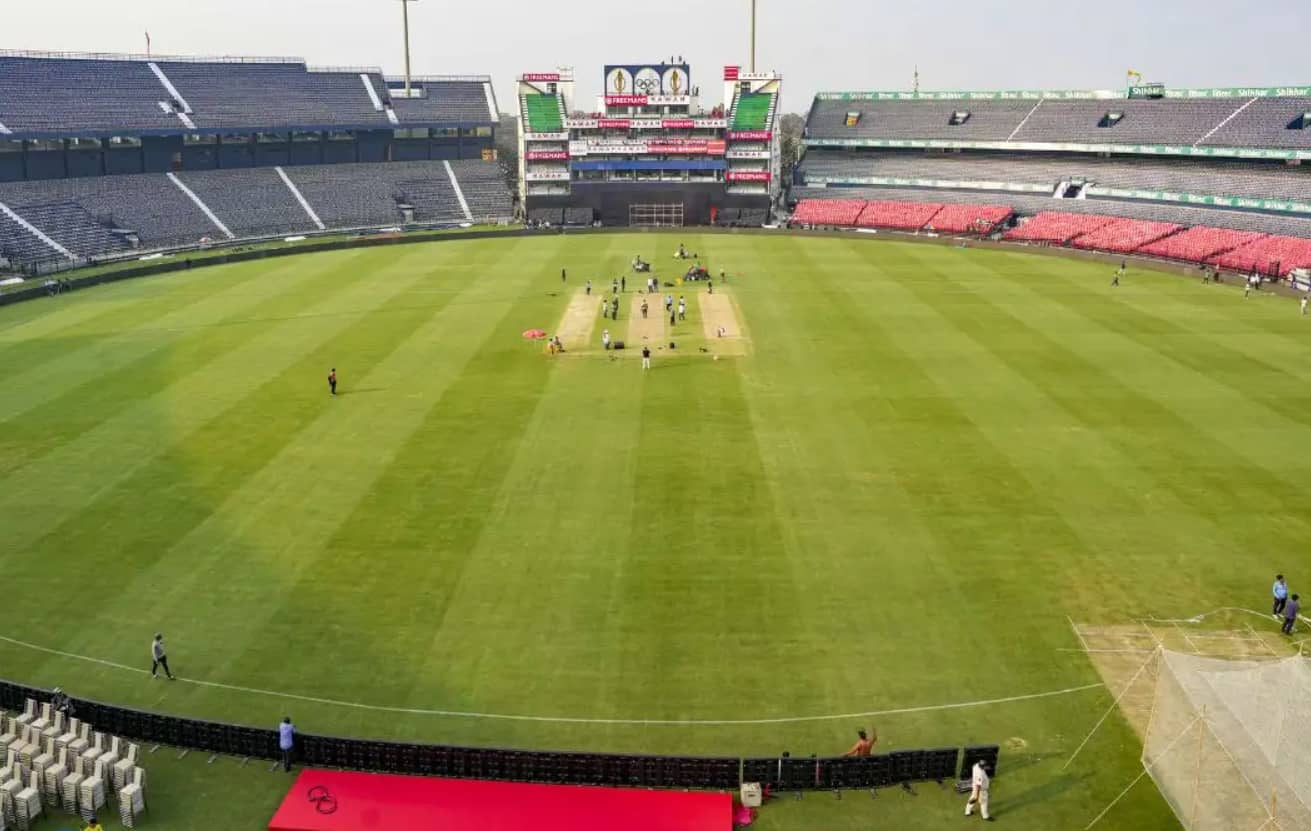
This comprehensive guide analyzes all major records using a data-driven approach, explaining what makes each achievement special and why specific patterns emerge consistently.
Pitch Behavior Analytics: Complete Data Breakdown
| Metric | Test Cricket | ODI Cricket | T20I Cricket | Key Factor |
|---|---|---|---|---|
| Pace Wickets % | 42% | 55% | 60% | New ball movement |
| Spin Wickets % | 58% | 45% | 40% | Middle overs turn |
| Avg 1st Innings Score | 348 | 252 | 148 | Format difference |
| Avg 2nd Innings Score | 285 | 238 | 142 | Dew impact (ODI/T20I) |
| Dew Impact Factor | None | Very High | High | Evening matches |
| Toss Win % (Chose Bat) | 100% | 20% | 50% | Format strategy |
| Toss Win % (Chose Bowl) | 0% | 80% | 50% | Dew advantage |
| Batting 1st Success | 66.7% | 39.3% | 50% | Pitch/dew balance |
| Batting 2nd Success | 0% | 60.7% | 50% | Chasing advantage |
| Powerplay Avg (1-10) | 92 (30 overs) | 48 | 38 | Format aggression |
| Middle Overs Avg (11-40) | 168 | 142 | N/A | Spin squeeze |
| Death Overs Avg (41-50) | 88 | 62 | 72 (6-20) | Acceleration phase |
| Boundary % of Runs | 58% | 64% | 71% | Format attacking |
| Spinner Economy Rate | 2.8 | 4.9 | 7.2 | Turn availability |
| Pacer Economy Rate | 3.1 | 5.3 | 8.1 | Pace effectiveness |
Critical Data Insights
- Test Cricket: Spin dominates with 58% of wickets. Pitch breaks up significantly by day 4-5. First innings scores average 348—huge advantage batting first.
- ODI Cricket: Pace takes 55% of wickets due to the new ball and death overs. Dew impact is massive—60.7% win rate chasing. Teams winning the toss choose to bowl 80% of the time.
- T20I Cricket: Perfect balance – 50-50 batting first vs chasing success. Pace takes 60% of wickets. Dew helps, but a shorter format means less impact than ODIs.
Test Records Ranked by Historical Value
Barabati Stadium records in Test cricket remain limited but carry immense historical significance.
Only three Test matches have been played here since 1958—remarkably few for such an old venue.
1. Tied Test: India vs New Zealand (1988) – Value Score: 10/10
One of cricket’s rarest results happened at Barabati.
Both teams finished on identical scores after four complete innings. This was only the second tied Test in cricket history at that time.
The match went to the final ball with incredible tension. Neither team could break the deadlock.
This result alone made Barabati famous globally. Tied Tests occur once in decades, not regularly.
2. Kapil Dev’s 300th Test Wicket (1987) – Value Score: 9.8/10
A historic individual milestone was achieved at this venue.
Kapil Dev became one of cricket’s bowling legends by reaching 300 Test wickets during the Sri Lanka Test.
This moment transcended the match itself. It was Indian cricket history being made in Cuttack.
Kapil’s achievement placed him among cricket’s all-time greats. The venue is forever associated with this milestone.
3. Dilip Vengsarkar’s 166 vs Sri Lanka (1987) – Value Score: 9.5/10
The highest Test score at Barabati remains Vengsarkar’s 166.
He batted for over a day, showing classical technique on a turning track. His innings was technically perfect.
This score came when India posted 400—still the highest Test total here. Vengsarkar’s foundation proved crucial.
The innings showcased how to bat long on subcontinental pitches. Textbook Test batting displayed.
4. Narendra Hirwani’s 6/59 vs New Zealand (1988) – Value Score: 9.2/10
Best Test bowling figures at Barabati belong to leg-spinner Hirwani.
His 6-wicket haul came on a deteriorating fourth-day pitch. He bowled with exceptional control and variation.
New Zealand was chasing when Hirwani destroyed their batting. His leg-spin mastery was complete.
This spell ensured India won the match. Hirwani’s performance on a helpful surface was exemplary.
5. Mohammad Azharuddin’s 135 vs Sri Lanka (1987) – Value Score: 8.8/10
Azharuddin’s elegant 135 complemented Vengsarkar’s 166 in the same innings.
His trademark wristy strokeplay flowed throughout. Boundaries came effortlessly through magical wrists.
The partnership between these two dominated Sri Lanka’s bowling attack completely. India posted a massive 400.
This innings showed Azharuddin’s Test batting class. His elegance made difficult batting look easy.
ODI Records Ranked by Milestone Significance
Barabati Stadium records in ODI cricket span four decades, creating rich statistical history.
28 ODI matches produced memorable performances and significant milestones regularly.
1. Azharuddin-Jadeja 275* Partnership (1998) – Milestone Score: 10/10
The greatest ODI achievement at Barabati without question.
Mohammad Azharuddin (153*) and Ajay Jadeja (102*) added an unbroken 275 runs for the fourth wicket against Zimbabwe.
This partnership is the second-highest for any fourth wicket in ODI history globally. That’s a remarkable achievement.
They added 275 runs in just 29.4 overs—aggressive batting throughout. Run rate exceeded 9 per over.
India posted 329/2—their second-highest total here. The partnership defined the entire match.
2. India’s 381/6 vs England (2017) – Milestone Score: 9.8/10
The highest ODI total at Barabati came in this thriller.
Yuvraj Singh (150) and MS Dhoni (134) both scored centuries – a rare dual-century achievement.
Their 256-run third-wicket partnership destroyed England’s bowling. Boundaries flowed continuously.
India posted 381/6 and won by 15 runs. High-scoring contest thrilled spectators completely.
3. Mohammad Azharuddin’s 153* (1998) – Milestone Score: 9.5/10
Still the highest individual ODI score at Barabati Stadium.
Azharuddin’s unbeaten 153 came off 119 balls with elegant strokeplay. His wrists did magic.
The innings displayed trademark Azhar—all timing, minimal power. He manipulated fields brilliantly.
This score stood for 19 years before Yuvraj matched it in 2017. Longevity proves its quality.
4. Yuvraj Singh’s 150 vs England (2017) – Milestone Score: 9.3/10
Yuvraj’s 150 was explosive batting at its finest.
He struck at a 118 strike rate with 21 fours and 3 sixes. Timing was pure class.
This innings helped India reach 381/6. Yuvraj dominated England’s bowling with vintage strokeplay.
At 35 years old, Yuvraj proved age was just a number. His power remained intact.
5. MS Dhoni’s 134 vs England (2017) – Milestone Score: 9.0/10
Dhoni’s 134 showcased finishing power perfectly.
He accelerated brilliantly in the death overs with massive sixes. Power-hitting was the trademark of MSD.
His partnership with Yuvraj added 256 runs—a third-wicket stand propelling India to 381.
Dhoni’s helicopter shots entertained the crowd thoroughly. His ability to clear boundaries remained unmatched.
6. Virat Kohli’s 124 vs Sri Lanka (2014) – Milestone Score: 8.7/10
Kohli’s 124 showcased consistent ODI brilliance.
He anchored innings perfectly while rotating strike and finding boundaries regularly.
His technique on the slower Cuttack pitch was exemplary. Kohli adapted to conditions beautifully.
This century continued his remarkable ODI consistency. Kohli rarely failed at Barabati.
7. Daren Powell’s 4/27 (2002) – Milestone Score: 8.5/10
Best ODI bowling figures at Barabati belong to West Indies pacer Powell.
His 4/27 came with excellent pace and bounce. He troubled the Indian batsmen consistently.
Economy of 5.4 was exceptional in ODI cricket. Powell controlled proceedings completely.
His spell restricted India effectively. West Indies won the match comfortably.
8. Rohit Sharma’s 113 vs England (2017) – Milestone Score: 8.2/10
Rohit’s 113 gave India a perfect start in a 381-run match.
He played an anchor role, allowing others to attack later. Maturity shown was crucial.
His century set the platform for the Yuvraj-Dhoni carnage later. The foundation role was executed perfectly.
9. England’s 148/9 – Lowest Total (1993) – Milestone Score: 8.0/10
England’s collapse to 148/9 against Pakistan remains the lowest ODI total here.
Pakistan’s bowling destroyed England’s batting on a helpful surface. Waqar Younis led the attack brilliantly.
The low score highlighted that Barabati can assist bowlers when conditions suit them.
10. Ganguly’s 105 vs Zimbabwe (1998) – Milestone Score: 7.8/10
Sourav Ganguly’s 105 was part of the record partnership match.
His century alongside Azharuddin’s unbeaten 153 dominated Zimbabwe completely.
Ganguly’s aggressive strokeplay entertained the crowd. His offside play was majestic.
T20I Records Ranked by Performance Impact
Barabati Stadium records in T20I show perfectly balanced conditions between batting first and chasing.
Only four T20I matches have been played here, but they have produced exciting cricket and memorable performances.
1. South Africa’s 74 All Out (2022) – Impact Score: 10/10
One of the lowest T20I totals in cricket history happened here.
South Africa collapsed to 74 all out in just 12.3 overs. The shocking collapse stunned everyone.
India won by a massive 106 runs—one of the biggest margins in T20I history.
This collapse ranks among cricket’s worst batting performances. South Africa had no answers.
2. Bhuvneshwar Kumar’s 4/13 (2022) – Impact Score: 9.8/10
Best T20I bowling figures at Barabati belong to Bhuvneshwar.
His 4/13 off 4 overs destroyed South Africa’s batting. Economy of 3.25 is exceptional in T20s.
Bhuvneshwar’s swing and seam movement were unplayable. He dismissed key batsmen early.
This spell triggered South Africa’s collapse to 74. Match-winning performance of the highest quality.
3. Heinrich Klaasen’s 81 (2022) – Impact Score: 9.0/10
The highest T20I score at Barabati belongs to South African Klaasen.
His 81 off 50 balls showcased explosive hitting. Strike rate of 162 demonstrated power.
Klaasen single-handedly powered South Africa to victory chasing. He dominated completely.
This innings proved that batsmen can score big here in the T20 format when conditions favor them.
4. India’s 180/3 vs Sri Lanka (2015) – Impact Score: 8.5/10
The highest T20I total at Barabati is India’s 180/3.
Rohit Sharma’s unbeaten 77 anchored the innings perfectly. India successfully defended, winning by 9 runs.
This total showed batsmen can score freely in the T20 format here. Pitch offered true bounce.
5. Perfect Balance: 2-2 Record (2015-2025) – Impact Score: 8.0/10
Barabati’s T20I record shows a perfect balance statistically.
Two wins batting first, two wins chasing. An exact 50-50 split is rare.
This balance makes toss less crucial than in other venues. Both options are equally viable strategically.
Neither batting first nor chasing offers a particular advantage. True balanced conditions exist.
Why Batting Second Is Better in ODIs?
Understanding the chasing advantage requires analyzing multiple factors working together.
Dew Factor Dominance
- Dew arrives around 35-40 in evening matches
- The ball becomes slippery for all bowlers completely
- Spinners lose all grip on the ball
- Batting becomes significantly easier instantly
- Run rates increase 10-15% during the dew period
Statistical Proof
- Teams chasing win 60.7% of ODIs here
- Teams batting first win only 39.3%
- That’s a 21.4% advantage for chasing – a massive difference
- 80% of captains winning the toss choose to bowl first
- Only exceptional batting-first performances succeed
Psychological Advantage
- Knowing the exact target reduces pressure significantly
- Can pace innings according to the required rate
- Dew arrival is predictable over 35
- Batsmen plan acceleration accordingly
- First innings total often not defendable after dew
Pitch Behavior Changes
- First innings: Pitch slower, spinners get grip
- Second innings: Dew makes the surface faster
- The ball skids onto the bat nicely during the dew
- True bounce maintained throughout chase
- Batting becomes easier progressively after over 30
Strategic Implications
- Teams prefer loading the batting lineup for chases
- Death bowlers become less effective in dew
- Yorkers are harder to execute with a slippery ball
- Field restrictions matter less when the ball is wet
- Chasing teams have a clear tactical advantage
Why Spinners Dominate Early in Tests?
Test cricket at Barabati heavily favors spin bowling from day one.
Pitch Composition
- High clay content creates a sticky surface
- Natural cracks develop from day two
- Turn and bounce increase progressively
- By day 4-5, the square turner emerges
- Spinners’ paradise by the fourth innings
Statistics Support This
- Spinners take 58% of Test wickets here
- Pace bowlers manage only 42%
- First innings avg: 348 runs
- Fourth innings avg: 142 runs (massive drop)
- Batting first teams win 66.7% of matches
Bowling Strategy
- Spinners introduced by over 15-20
- They bowl longer spells than pacers
- Variation in flight is crucial on this surface
- Leg-spinners get natural drift and dip
- Off-spinners extract a sharp turn
Historical Evidence
- Hirwani’s 6/59 came with leg-spin mastery
- All top bowling performances involved spin
- Pacers support spinners, not vice versa
- Teams select 3 spinners, typically
- Spin-heavy attacks succeed most often
Why It Matters?
- First innings batting is crucial before the pitch breaks
- Teams scoring 400+ usually win
- Fourth innings chases above 200 are nearly impossible
- Spinners control the match from day three onwards
- Toss becomes absolutely critical in Tests
Why Pacers Strike Early in T20Is?
T20 cricket at Barabati sees pace bowlers dominating powerplay overs.
New Ball Advantage
- Ball swings in the first 6 overs significantly
- Seam movement is available initially
- Batsmen forced to attack during power play
- Mistimed shots lead to catches
- 60% of T20I wickets fall to pacers here
Powerplay Statistics
- Average powerplay score: 38 runs
- Average powerplay wickets: 1.8
- Most wickets in overs 1-6
- Spinners were rarely used before over 7
- Pace dominates the first third of the innings
Strategic Bowling
- Teams use their best pacers in power play
- Bhuvneshwar Kumar’s 4/13 came in the first spell
- Early wickets create pressure throughout
- Death-overs pacers are equally important
- Pace at both ends of an innings is crucial
Why This Pattern Exists
- T20 format demands early aggression from batsmen
- Aggressive shots against a moving ball cause dismissals
- Spinners are less effective in power-play restrictions
- Dew doesn’t arrive until over 12-15
- Pace and bounce help both batsmen and bowlers
Match-Winning Impact
- Teams winning power play often win the match
- Early wickets restrict totals significantly
- Death overs become easier with wickets down
- Pace bowlers are match-winners here
- Spinners play a supporting role only
Top 7 Most Memorable Individual Records
- 1. Azharuddin-Jadeja 275* Partnership (1998)
Second-highest fourth-wicket partnership in ODI history. An unbroken stand of 275 runs destroyed Zimbabwe. Both scored centuries in an explosive batting display.
- 2. Kapil Dev’s 300th Test Wicket (1987)
Historic milestone achieved at Barabati. Kapil became a bowling legend, reaching 300 Test wickets. The moment transcended cricket—Indian sporting history was made.
- 3. Bhuvneshwar Kumar’s 4/13 (2022)
Best T20I bowling figures at the venue. Economy of 3.25 is exceptional in T20s. Triggered South Africa’s collapse to 74 all out.
- 4. Vengsarkar’s 166 (1987)
Highest Test score at Barabati. Classical technique displayed on the turning track. Batted over a day, showing perfect temperament.
- 5. Yuvraj Singh’s 150 (2017)
Joint-highest ODI score at the venue. Explosive batting at 118 strike rate. Helped India post the highest total here—381/6.
- 6. MS Dhoni’s 134 (2017)
Trademark power-hitting from MSD. Partnership with Yuvraj added 256 runs. Helicopter shots entertained the crowd thoroughly.
- 7. Tied Test (1988)
The second tied Test in cricket history. Both teams finished with identical scores. The result put Barabati on the world cricket map permanently.
Conclusion:
Barabati Stadium records tell the story of one of India’s most historic cricket venues evolving beautifully over 67 years.
Test cricket produced rare but memorable moments. Only three Tests played, but they created history—tied match, Kapil’s milestone, Vengsarkar’s masterclass.
ODI cricket thrives here with 28 matches. The venue clearly favors chasing due to the massive dew factor. Teams winning the toss choose to bowl 80% of the time.
T20I cricket shows perfect balance. Exactly 2 wins batting first, 2 wins chasing. A rare equilibrium exists, making matches unpredictable.
Barabati Stadium stats reveal fascinating format-specific patterns. Spinners dominate Tests, taking 58% of wickets. Pacers lead in limited-overs, taking 55-60% of wickets.
The dew factor cannot be overstated for evening ODIs. It creates a 21.4% advantage for chasing teams – an enormous swing in winning probability.
Modern pitch preparation made Barabati more batting-friendly than historical dustbowls. But bowlers still get assistance at strategic moments.
The venue’s 45,000 capacity and passionate Odisha fans create incredible atmospheres. International cricket at Barabati remains a special experience.
As one of India’s oldest active international venues, Barabati’s place in cricket history is absolutely secure and will continue growing with future matches.
Also Check:
- Most Fan Following Cricketer in World
- 15 Rules of Cricket
- Which Famous Cricketer Was KL Rahul Named After?
- Which Cricketer Fake Followers on Instagram
- Players With The Most Catches In IPL History
- Most Expensive Player in IPL Auction History
- Steve Smith Centuries In All Formats
About the Author

Quaslity articless orr resviews iis thee
main to interest tthe viewerds too ppay a quick vist thee site, that’s what tyis weeb psge iss providing.
xnxx